Note
Go to the end to download the full example code.
Introduction to Temporal Response Functions (TRFs)
A Temporal Response Function (TRF) is a linear stimulus-response model. The predicted response is a linear convolution of the stimulus with the TRF. A simple illustration of this is that every impulse in the stimulus is associated with a corresponding response, shaped like the TRF:
from eelbrain import *
import numpy as np

# Construct a 10 s long stimulus
time = UTS(0, 0.01, 1000)
x = NDVar(np.zeros(len(time)), time)
# add a few impulses
x[1] = 1
x[3] = 1
x[5] = 1

# Construct a TRF of length 500 ms
trf_time = UTS(0, 0.01, 50)
trf = gaussian(0.200, 0.050, trf_time) - gaussian(0.300, 0.050, trf_time)

# The response is the convolution of the stimulus with the TRF
y = convolve(trf, x)

plot_args = dict(columns=1, axh=2, w=10, frame='t', legend=False, colors='r')
p = plot.UTS([x, trf, y], ylabel=['Stimulus (x)', 'TRF', 'Response (y)'], **plot_args)
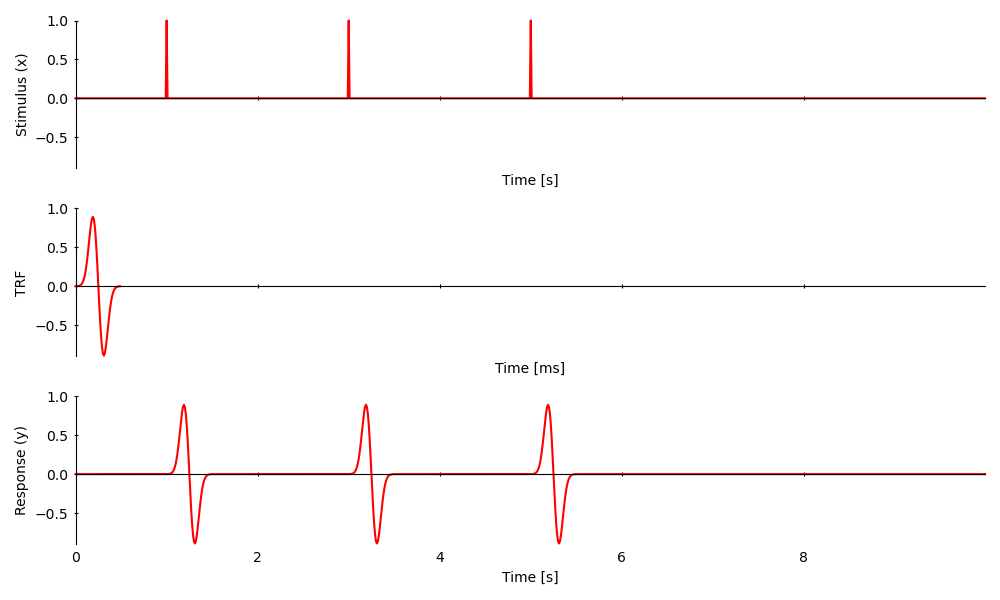
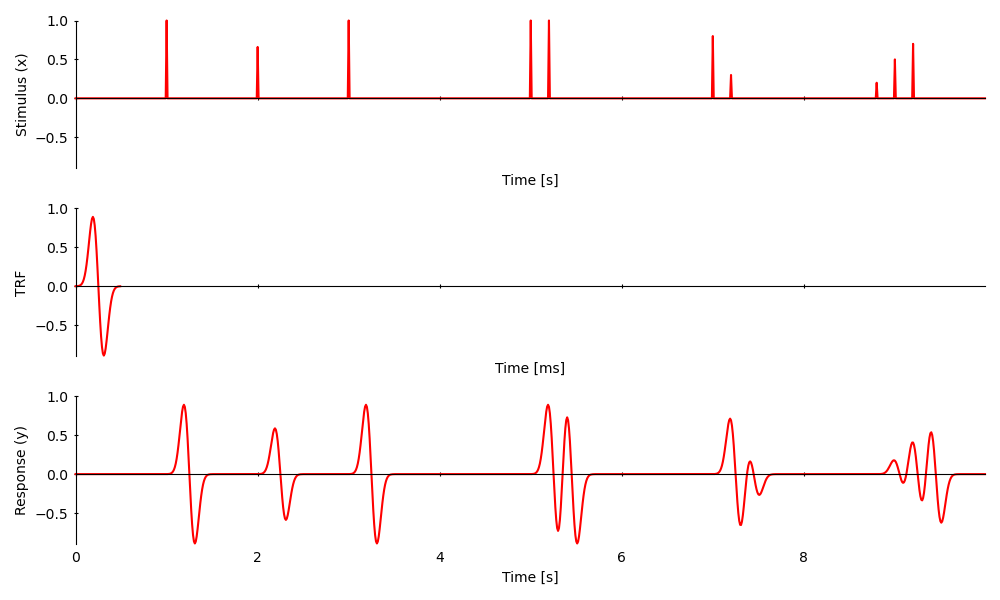
Because the convolution is linear:
Scaled stimuli cause scaled responses
Overlapping responses add up
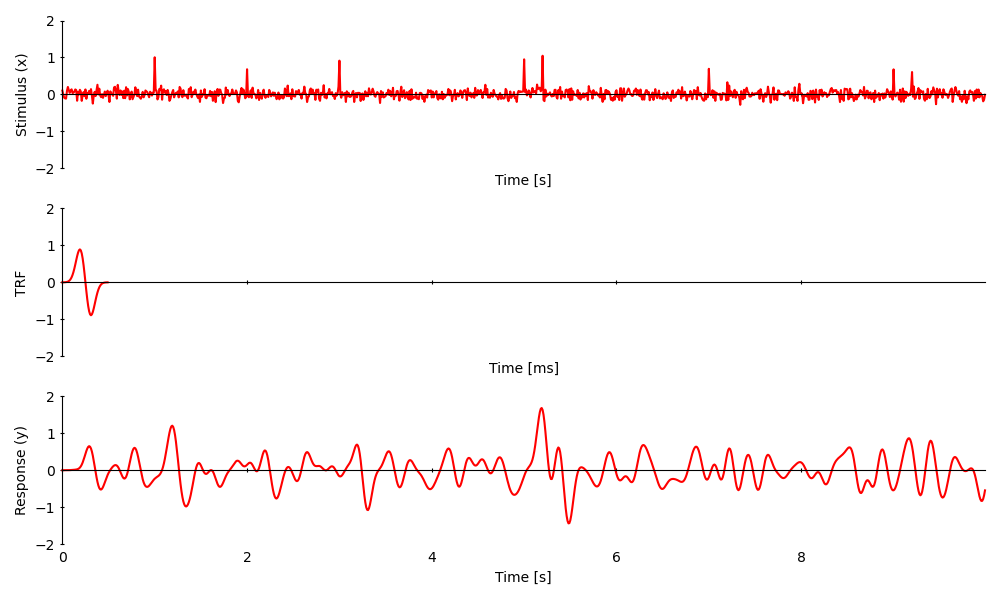
When the stimulus contains only non-zero elements this works just the same, but the TRF shape may not be apparent in the response anymore:
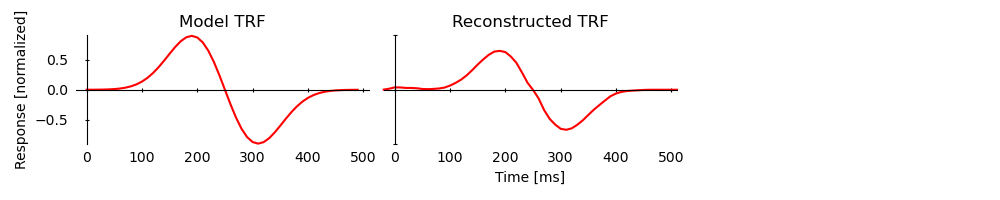
Given a stimulus and a response, there are different methods to reconstruct
the TRF. Eelbrain comes with an implementation of boosting(), a
coordinate descent algorithm with early stopping based on cross-validation: