Note
Go to the end to download the full example code.
ANOVA
This example performs mass-univariate ANOVA using testnd.ANOVA.
The example shows a 2 x 2 repeated measures ANOVA.
For specifying different ANOVA type models see the test.ANOVA documentation.
The example uses simulated data meant to vaguely resemble data from an N400 experiment
(not intended as a physiologically realistic simulation).
from eelbrain import *
Simulated data
Use datasets.simulate_erp() to generate a dataset
simulating an N400 experiment, as in the T-test example.
Set short_long=True to simulate word length as a second variable,
resulting in a 2 x 2, predictability x word length design.
s_datasets = []
for subject in range(10):
    # generate data for one subject
    s_data = datasets.simulate_erp(seed=subject, short_long=True)
    # average across trials to get condition means
    s_data_agg = s_data.aggregate('predictability % length')
    # add the subject name as variable
    s_data_agg[:, 'subject'] = f'S{subject:02}'
    s_datasets.append(s_data_agg)

data = combine(s_datasets)
# Define subject as random factor (to treat it as random effect in the ANOVA)
data['subject'].random = True
data.head()
Re-reference the EEG data (i.e., subtract the mean of the two mastoid channels):
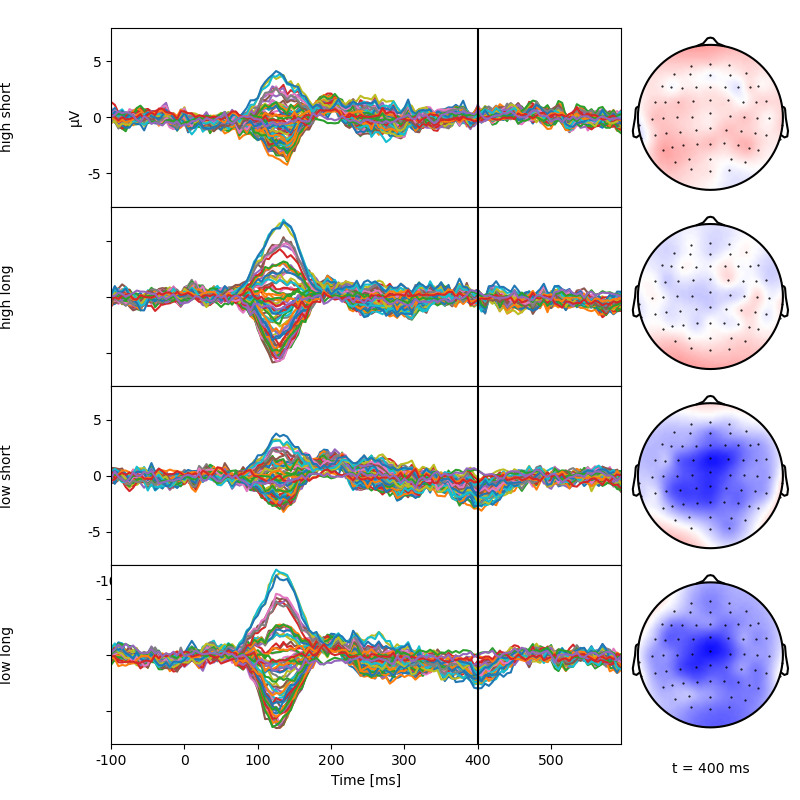
Plot the data by condition to illustrate the effect. Note 2 effects in the simulation: an early ~130 ms peak determined by word length, simulating increased visual processing for longer words; and a later “N400” predictability peak, simulated to be larger for more surprising (less predictable) words.
p = plot.TopoButterfly('eeg', 'predictability % length', t=.400, data=data, axh=2, w=8, clip='circle')
Spatio-temporal test
testnd.ANOVA provides an interface for mass-univariate ANOVA.
The ANOVA function determines whether to perform a repeated measures or fixed effects ANOVA based on the model.
Here, 'predictability * length * subject' is a repeated measures ANOVA because we defined data['subject'] as random effect above.
Changing the model to 'predictability * length' would perform a fixed effects ANOVA.
result = testnd.ANOVA(
    'eeg',
    'predictability * length * subject',
    data=data,
    pmin=0.05,  # Use uncorrected p = 0.05 as threshold for forming clusters
    tstart=0.050,  # Find clusters in the time window from 100 ...
    tstop=0.600,  # ... to 600 ms
    samples=1000,  # smaller number of permutations to speed up the example; use 10'000 when the exact p-value matters
)
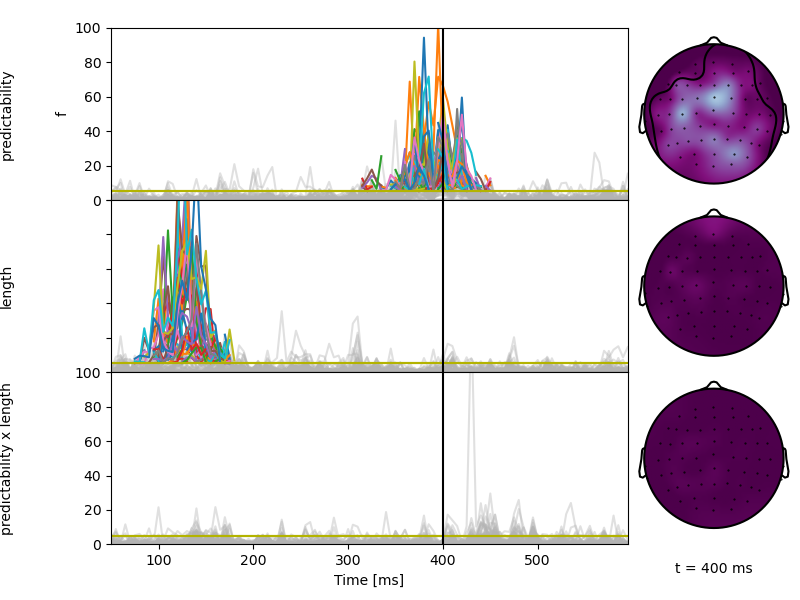
The default visualization shows F-values over time.
A yellow line indicates the F-value corresponding - the pmin=0.05 parameter.
In the butterfly plots, line segments that are part of a significant cluster are shown in color.
In the topographic map, significant clusters are shown by outline.
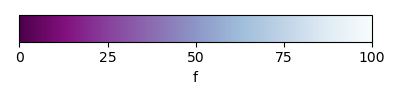
p = plot.TopoButterfly(result, t=.400, axh=2, w=8, clip='circle', vmax=100)
_ = p.plot_colorbar()
The corresponding F-maps can be accessed on the result object:
[<NDVar 'predictability': 140 time, 65 sensor>, <NDVar 'length': 140 time, 65 sensor>, <NDVar 'predictability x length': 140 time, 65 sensor>]
Corresponding cluster statistics:
result.find_clusters(0.05)
Total running time of the script: (0 minutes 11.881 seconds)